Holiday Money Stress? 6 Ways to Free Up Cash Flow This Season
Holiday spending lands on top of balances many people already carry. Here are practical ways to free up monthly cash, with charts showing how rate and payment size change the cost.
Your balance may not be zero yet, but there are clear signs you are moving in the right direction. Here are five ways to measure real progress on debt.
2 min readChecking reading status...
Your next step, on your terms.
Explore loan options without affecting your credit score.
Set a hard holiday number first, and pay for it from cash flow, not from a card you cannot clear.
Lowering the interest rate or the number of payments is how you free up monthly cash, so compare options before the bills arrive.
A consolidation loan or a debt resolution program can help some people, but both have tradeoffs, so read the terms and ask about total cost.
The holidays are expensive, and for many households they land on top of balances that were already hard to carry. If you feel stretched this time of year, you are not alone, and there are practical ways to free up cash before the bills show up in January.
How common is holiday debt?
LendingTree's 2025 holiday survey of more than 2,000 U.S. adults found that 37% took on holiday debt, averaging $1,223, up from $1,181 the year before. Among parents of kids under 18, 48% borrowed, averaging $1,324. About 63% of people with holiday debt expected it to take three months or longer to pay off.
The AICPA and Harris Poll found that 47% of people planning to spend on holiday gifts or travel expected to go into debt. Credit card rates currently average above 20%, according to Bankrate, so a balance you carry gets expensive quickly.
A useful checkpoint for any financial decision, no matter which path you explore.
Step 1: Set a number before you shop
Add up gifts, food, travel, decorations, and one buffer line for surprises. Then decide what you can pay in cash from this month's income. Anything above that number is borrowing, so decide on purpose rather than at the register.
Step 2: Find cash in what you already pay
Look for small recurring costs you can pause for 60 days:
Streaming and app subscriptions you rarely use
Delivery fees and convenience spending
Gym or box memberships you can freeze
Insurance or phone plans you can shop around
Even $100 a month redirected to your highest-rate card matters. At a 21% APR, the average holiday balance of $1,223 takes about 33 months to clear at $50 a month, 14 months at $100, and 7 months at $200 (an example calculation, not a quote). The extra payment does not just shorten the timeline. It cuts the interest you pay from roughly $387 to $165 to $82.
Step 3: Hold off on buy now, pay later stacking
Several small installment plans feel manageable one at a time, but they add fixed payments to your budget for months. Count every installment as a bill before you add another.
Step 4: Ask your card issuer for help early
If January looks tight, call before you miss a payment. Ask about a hardship program, a lower rate, or a temporary reduced payment. Many issuers have options, but they are usually easier to get before an account goes late.
Step 5: Look at what consolidation can do for your cash flow
If you carry balances on several cards, a debt consolidation loan can replace them with one fixed payment and a set end date. It can free up cash in two ways: a lower interest rate than your cards, and a payment you can plan around.
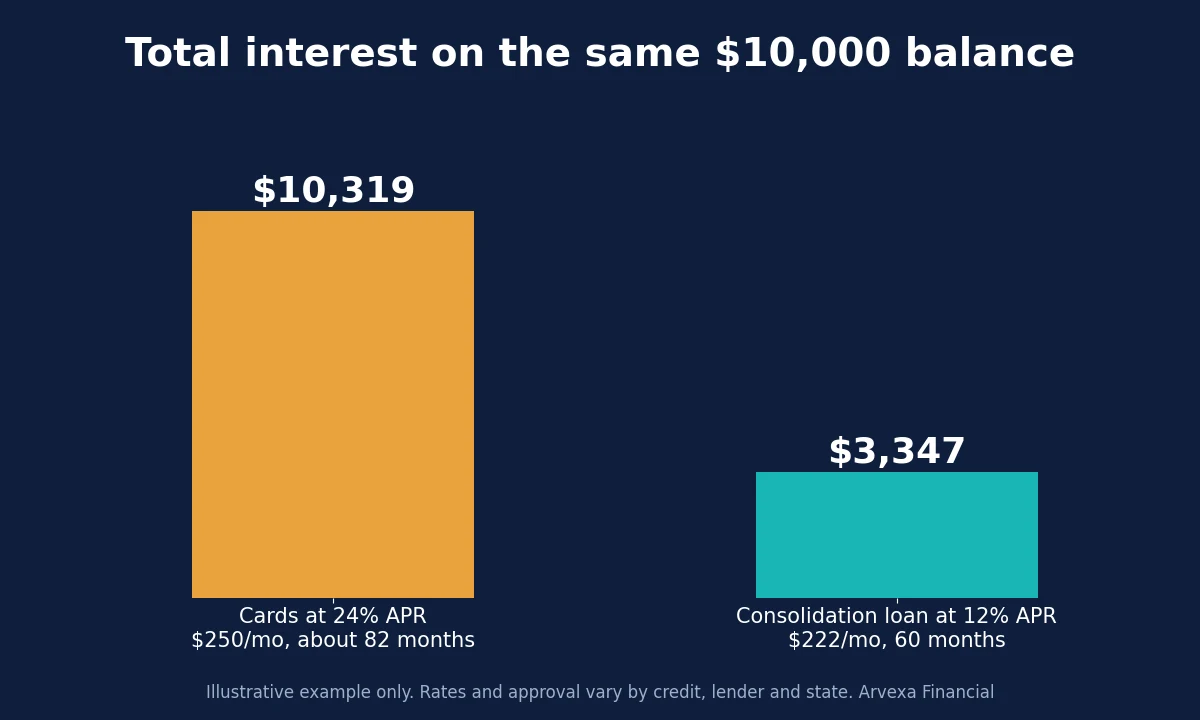
Here is an illustrative example, not an offer. Say you owe $10,000 across cards at 24% APR and pay $250 a month. That takes about 82 months and costs about $10,300 in interest. The same $10,000 on a 60 month loan at 12% APR would be about $222 a month and about $3,350 in total interest. Your actual rate depends on your credit, income, the lender, and your state, and some people will not qualify. Check for origination fees and compare the total cost, not just the monthly payment.
Step 6: When the numbers do not work, look at debt resolution
If your required payments are more than your budget can handle, a debt resolution program (also called debt settlement) may be worth understanding. These programs negotiate with creditors for less than the full balance, usually after you stop paying and build up funds in a dedicated account. The tradeoffs are real: your credit can drop, collection activity and late fees can continue while you wait, forgiven debt can be taxable, and results are not guaranteed. Federal rules also prohibit charging fees before a settlement is reached. Ask about every fee, the full timeline, and what happens if a creditor does not agree.
A nonprofit credit counselor is another option worth a call, because they can review your whole budget and explain a debt management plan.
A simple holiday cash flow check
Before you spend another dollar this season, write down:
Your take-home pay this month
Your required payments (rent, utilities, minimums)
What is left for holiday spending
Your plan to pay off anything you put on a card
If the last line is blank, pause and run the numbers on consolidation, a hardship request, or a resolution program first.
Free guides and next steps
Arvexa Financial publishes free education on debt payoff, consolidation, and settlement, so you can compare options before you decide.
Marked read when you reach this ending. Saved only in this browser, with no login. Clearing site data removes your reading history. Marking unread keeps it unread for the rest of this visit.
A simple step-by-step plan for paying off a $4,000 credit card balance, with an example of how interest and monthly payments change your payoff timeline.
Companies that charge per deletion often run into federal rules. Here is what the law says about upfront fees, what can come off a credit report, and what you can do for free.